& occasionally about other things, too...

Friday, January 31, 2020

A Delhi Obsession


Image result for mg vassanji"
MG Vassanji
In 2012, I had been in Canada just four years and read Indian newspapers online regularly. I discovered an interview of MG Vassanji in India’s Mint newspaper when his novel The Magic of Saida was published.  The interview was competent, or so I thought. It covered all the things that a newspaper reader would want to know about an author.    

I sent the link to Vassanji, thinking that he would be delighted. I told him that I had posted the link on social media. He told me to remove the link. He was actually livid. 

I asked him why, and said, “They have labelled me. Would they have called Margaret Atwood a Christian author? Or Amitav Ghosh a Hindu author? I doubt it; they wouldn’t. Then, why label me as an Ismaili Muslim.”

I didn't quite understand his anger then. But over the years, as I have got to know him a bit better, I have begun to comprehend his irritation over being labelled. 

It is impossible to categorise Vassanji on the basis of faith or nationality because it is impossible to fit him into a specific ethnic, religious, national silo. 

He is like the Indian raita (an Indian dish of finely chopped cucumber, peppers, mint, etc. in yoghurt, served with curries). The Indian raita spreads on an Indian thali, freely mixing with different vegetables and curries in the thali, and in the process, both acquires their taste and gives its own flavour to them.

Ismaili-Khoja culture is a mix of both Hindu and Islamic traditions, blending the streams into a fusion of Sufi/Bhakti. Although today’s generation believes in having a distinct as opposed to a defused identity, the religious songs of the Ismaili-Khojas called Ginans reveal the strong syncretic roots of the community.

To help me understand the unique syncretism that has made him who he is, Vassanji had sent me a review of a book on Ginans. (Ginanic Travails: Conflicted Knowledge)

Over the years, in many a heated discussion about the religious tensions in India that we have had, Vassanji invariably points out the tendency amongst Indians to label people; even Indian liberals are not above the labelling, he would complain. This labelling leads to stereotypical understanding and portrayal of the two communities in general, but especially of the Indian Muslims.

Finally, in 2019, with A Delhi Obsession Vassanji has published a novel that sensitively depicts the insensitive Indian habit of identifying and categorizing people on the basis of their religion. 

The novel is a love story, an illicit love story between a married Hindu middle class woman in Delhi and a Muslim widower from Toronto, who is uncomfortable every time everyone identifies him as a Muslim.

Early on in the story, when the newly-in-love couple visit a shrine, the tension over identity is palpable.
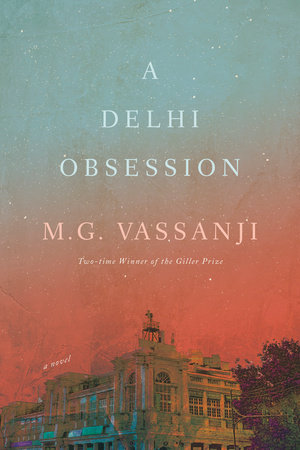
Image result for a delhi obsession"“The shrine was modestly decorated with marigolds and an idol of a god, behind which quietly sat the priest. Mohini covered her head with her sari end, joined her hands and knelt before the idol, Munir looked around nervously, then shakily half-knelt beside her, joining his hands, too. The priest gave them some water, which following Mohini, Munir sipped from his hand, dabbing his head with what remained. The watching priest then gave them each some coarse sugar pellets.

When they were outside, back in the brightness, she turned to him and said, “But you are a Muslim.”

He took a breath, then replied, “If you say so. But I don’t describe myself by a faith.”

He felt stupid saying that, but it was the naked truth.

“But you bowed to our gods.”

“Your gods…Well, I paid my respect to the gods.”

“What are you, then?”

“Do I have to be something?”

“How do people know you, then?”

“As just another person. A friend. A neighbour. An author.”

Towards the end, when the Hindu nationalist rabble rouser Jetha Lal and his brutish acolytes surround Munir at the club, threatening him, Munir exclaims in despair and anger, “I’m a Canadian. Don’t put your labels on me.” To which the uncouth Jetha Lal patiently responds, “Canadian, sir. But you like Hindu women, I see. Better than Canadian women, no?” He waited. “No doubt. But you are Muslim, sir. Mlechha. Different.” 

(The word Mlechha is italicised perhaps to emphasize it, not because it is an Indian word).

A Delhi Obsession is an incisive portrayal of the unbearable intensity of Hindu nationalism that is rapidly transforming India into an intolerant, bigoted place where fear rules. Expectedly, the novel ends tragically; illicit love stories often do. But the end is as unexpected, sudden, brutal as the end of the popular Marathi film Sairat. The end keeps you awake at night, long after you have read the last page. 

I apologise for spoiling the reading experience of those who haven't yet read the novel, but I was horrified by the end of the story. In half a page, it brought alive the horror that is India today.

Monday, January 13, 2020

The Power of Opportunity - Richard Rothman


Long before the present publishing boom began in India, Richard Rothman, then a bureaucrat with the United States Government in India, published a collection of short stories that was breathtakingly original.

Then, being the maverick that he has always been, Richard kicked his comfortable job to launch his own consultancy – in an area nobody would've thought of as a business proposition – Opportunity.

His second book on the subject The Power of Opportunity is being launched in Bombay later in January. In a short, e-mail interview, he talks about his book and ‘Opportunity’.

Richard’s consultancy Open Mind Consultancy has teamed up with the Penguin India team to create a very India-centric roadmap to both individual and business success.


What is this book about?

The Power of Opportunity presents a thorough methodology of thought and action on personal and business opportunities. It is the first book to attempt to do this since Edward DeBono published his book Opportunities in 1978.

Why is the book titled The Power of Opportunity?

Because opportunities have tremendous power to change our lives for the better. They are the seeds from which all success grows. For example, a couple years ago I met a 20-year-old entrepreneur, still a boy really, who had dropped out of college to develop an internet app. This boy, from a very modest background in Bihar, had managed to raise $20 million from Tiger Global, a major US venture capital firm.

This example highlights two fundamental things that give opportunities tremendous power:

1) all opportunities are free. You can't pay for them even if you want to. There is no “opportunity shop” where you can buy them. That means that opportunities are available to even to penniless boys from Bihar.

2) the best opportunities are like powerful magnets that attract all the resources needed to scale them. Why had Tiger backed him? Was it because of his track record? Obviously not. Tiger was pouring resources into the opportunity, not the entrepreneur.

But resources flow only to the best opportunities, what I call golden opportunities.
Therefore, it is crucial to consciously choose opportunities by using a systematic process, and not rely on luck, as most people do. Unfortunately, most people end up pursuing Nopportunities, which are not opportunities, because they don't use a systematic process to choose them.

This is the second book you have written on opportunity. How is The Power of Opportunity different from Master Opportunity and Make it Big?

My previous book, Master Opportunity and Make it Big, presented the stories of 18 "Opportunity Masters" who had started with nothing and made it big by taking advantage of excellent opportunities.  Although all of these people had succeeded, they did not necessarily understand why. In The Power of Opportunity, I present a methodology of thought and action which is based on my experience with the over 2,000 businesses I have consulted with over the past 30 years as both an Opportunity Consultant and Trade Commissioner. Therefore, it is an original theory which I have developed.

You're probably the only Opportunity Consultant in the world, what exactly do you do or can do for corporations and for individuals.

As the first and only Opportunity Consultant in the world, I offer companies a systematic process to uncover, recover and discover opportunities for sustained, profitable growth. How am I different from other management consultants? Most follow the principles of strategy developed by Michael Porter and others, which uses “competitive advantage” as the main filter through which to view opportunities. I’ve found that using competition as a filter can lead to increasing market irrelevance over time. After all, do your competitors buy your products? Are they part of your team? Of course not. I focus instead on providing useful service to stakeholders.

You have worked in India for the last 25 years, in terms of your specialisation (Opportunity) how has the Indian market changed? Are there more tangible opportunities at present then there were in the early years of economic liberalisation.

On a macro level, I firmly believe that India is the greatest land of opportunity in the world today. Half of India’s population are still subsistence farmers, a business model which is fundamentally broken in the modern age. Over the coming decades, they will move to cities and take better opportunities as wage earners and entrepreneurs. Since the demise of the License Raj in 1991, the Indian opportunities landscape has liberalized - but it still has a long way to go. The government has got to focus less on ideology and more on growth through opportunities.

In your sphere of expertise (identifying opportunities) what changes have you noticed in India over the last two decades?

The Indian mindset is gradually shifting from the pre-license raj mode of opportunity through connections, bribery and extortion, toward a modern rules-based system that rewards opportunity based on merit. This migration to the rules of the modern era will take decades, but the trend is in the right direction, and India will benefit from it.

You have published an amazing collection of phantasmagorical short stories and a novel.  Why did you abandon writing fiction?

I haven't abandoned fiction. I plan to resurrect and publish my novel eventually. But at this point I'm focused on spreading the mantra of Opportunity.

You may buy the book here (in India): The Power of Opportunity

Kindle edition is available here (in Canada): The Power of Opportunity


Thursday, December 26, 2019

A requiem for Indian secularism?


As 2019 draws to a close and we look back at the events of the past year, reflect upon the gains and the losses and the lessons learnt, the one issue that is impossible to ignore is the rapid decline of secularism in India.

The Modi regime, backed by a solid parliamentary majority it got in 2019, has set into motion changes that have fundamentally altered India by forcibly extinguishing its secular ethos.

Although, India proudly claims to be the largest democracy in the world, democracy in India has largely been confined to the successful holding of elections.

For democracy to be meaningful, adherence to other sacrosanct principles of democracy are necessary. These principles include respect for democratic institutions, a legislature that engages in meaningful debate, independent judiciary, a free and thriving media that encourages debate and dissent.

Under the new Modi regime, democratic norms have been severe constricted. Today, India under Modi has no patience for secular principles and is keen to enforce aggressive majoritarianism.

Two events that demonstrated this tendency are:

  • The lockdown in Kashmir
  • The passage of the Citizenship Amendment Act and the implementation of the National Register of Citizens.
The Modi regime found a semblance of support for its assertive moves in Kashmir, primarily because many in India believe that the stalemate in Kashmir needs to be resolved. And if old methods haven’t yielded results in the last seven decades, new methods must be tried.

However, the lockdown of the state and its people since August 2019 is unacceptable, and a gross violation of people’s rights to freedom.

When the exercise of identifying illegal immigrants was launched in Assam after Modi was reelected, it raised legitimate concerns because New Delhi now had a government that swore by majoritarianism, and was not above using the state’s enormous reach to propagate its exclusivist philosophy of aggressive Hindutva.

Pertinently, the exercise of implementing the NRC in Assam proved how difficult, if not impossible, it would be for a large number of people to prove their Indian citizenship. Nearly two million people (including Hindus) could not prove that they were Indians. 

Perhaps in recognition of the anomaly that the NRC would result in the exclusion of Hindus, as well, the Modi regime amended the citizenship act to accord citizenship rights to non-Muslim immigrants from Afghanistan, Bangladesh and Pakistan.

Modi’s supporters may claim that the amendment is to help minorities in these countries emigrate to India. But the fact is that the purpose of both the NRC and the amended citizenship act is to exclude Muslims.

Amit Shah, India’s Home Minister and the second-most important minister in the Modi regime openly declared that the citizenship register would be implemented across India to ferret out illegal immigrants.

“It is our commitment to implement National Register of Citizens (NRC) across the country to weed out the infiltrators. First, we will bring the Citizenship (Amendment) Bill to ensure that eligible refugees get citizenship, and then we will introduce NRC to throw out the infiltrators. They are termites, they are eating into the country's resources,” Shah asserted.

He declared in the Indian Parliament, “Maan ke chaliye, NRC aane wala hai.” (Take it as a given that the NRC will be introduced across the country).

In July 2019, when the implementation of the National Citizens Register was launched in Assam, the following protest poem, “I am a Miya’ written by Hafiz Ahmed spread like wildfire on the internet.

Write Down ‘I am a Miya’

Write
Write Down
I am a Miya
My serial number in the NRC is 200543
I have two children
Another is coming
Next summer.
Will you hate him
As you hate me?

Write
I am a Miya
I turn waste, marshy lands
To green paddy fields
To feed you.
I carry bricks
To build your buildings
Drive your car
For your comfort
Clean your drain
To keep you healthy.
I have always been
In your service
And yet
you are dissatisfied!

Write down
I am a Miya,
A citizen of a democratic, secular, Republic
Without any rights
My mother a D voter,
Though her parents are Indian.

If you wish kill me, drive me from my village,
Snatch my green fields
hire bulldozers
To roll over me.
Your bullets
Can shatter my breast
for no crime.

Write
I am a Miya
Of the Brahamaputra
Your torture
Has burnt my body black
Reddened my eyes with fire.
Beware!
I have nothing but anger in stock.
Keep away!
Or
Turn to Ashes.

Translated by Shalim M. Hussain

Will this protest poem be a requiem for India’s secularism?

The internet informs me that a requiem “is a religious ceremony performed for the dead. ... The word requiem comes from the opening words of the Roman Catholic Mass for the Dead, which is spoken or sung in Latin (requies means “rest”).

In a nonreligious context the word refers simply to an act of remembrance.”

Some of the biggest composers of western classical music have composed requiems, and one of the most memorable compositions is Clint Mansell’s Lux Aeterna for Darren Aronofsky’s 2000 film Requiem for a Dream

(You may listen to it here: Clint Mansell – Lux Aeterna – Requiem for a Dream).

'I am a Miya' will be a requiem for Indian secularism if the world allows India’s Modi regime to continue with its persecution of Indian Muslims.

Watch the video here:


Tuesday, November 26, 2019

Song of Silence - Sangeeta Gupta's paintings


Curator’s Note by Meena Chopra

In an ongoing journey with five elements of life, Sangeeta Gupta reveals the hidden realms of creativity by bringing it to the conscious levels through her art. There is a sustained intricacy of mystique, in the entire range of her work. 

The obscurity of abstract forms start speaking to one in a silent melody and a continuous song is created within the limits of space and time through the subjective experience.  Undoubtedly a spontaneous painter, the vision of her inner world is very clearly and honestly depicted in both her poetry and art. 

In her latest works, there is a kind of explosion of forms in contrasting tones and colours which give a powerful sense of free-spiritedness. This instantly grabs the attention of the viewer's eye and draws it deeply into the subtleties of forms and tones, thereby creating a continuous dialogue between the inner and outer worlds. 

What strikes me most in her art is the sincerity, through which the subconscious flows out naturally, impulsively and effortlessly through her art.
Fellow Artist and Curator Meena Chopra

Continued in the post below