& occasionally about other things, too...
Showing posts with label Jawaharlal Nehru. Show all posts

Friday, October 31, 2014

The realm of tomorrow

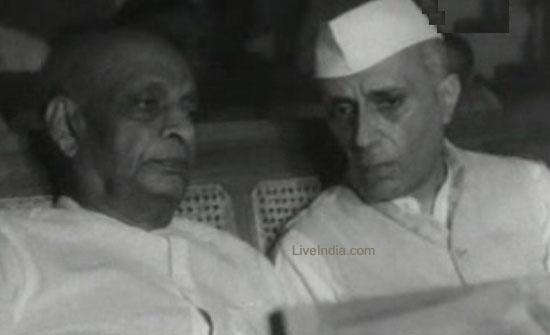
Jawaharlal Nehru and Vallabhbhai Patel
The present dispensation in India (articulated by the head of the ruling party) has sparked an unseemly debate by making counterfactual historical claims that India’s first Deputy Prime Minister Sardar Vallabhbhai Patel would, in fact, have made a better Prime Minister than Jawaharlal Nehru. 

Of course, the real reason for instigating the "debate" is the deep rooted hatred that the present dispensation harbours against India’s first Prime Minister.

Jawaharlal Nehru doesn’t need to be defended. He will be always be taller than the tallest statue that may be built for anyone anywhere in India.

Here’s an extract from B. R. Nanda’s (1917-2010) The Nehrus (originally published in 1962 and then updated in the 1980s), describing Nehru.

Jawaharlal Nehru’s was a rich, varied and complex personality. Though born with a silver spoon in his mouth, and reared in the nurseries of the British aristocracy, he was destined to spend the best part of his life in railway trains, public meetings and prisons. He was no orator; his speeches were calculated not so much to impress or humour his admiring audiences, as to instruct and re-educate them. Over his countrymen he came to exercise a magnetic influence; as he says in his autobiography, he took to the crowd and the crowd took to him. But he was an intellectual with a deep strain of loneliness, the compassion for suffering humanity. He could abstract himself from his immediate surroundings even in the midst of a formal banquet or a state reception, and was most relaxed in the company of children and animals. Mountains with their snows and solitude fascinated him. He loved beautiful things, paintings, sculptures and books. In prison he had time to reflect on the five thousand years of India’s past, and to connect it with her present and future. As the American journalist Norman Cousins, put it, Nehru’s intellect was rooted in the Enlightenment but his spirit was in the Vedas. He was a writer of distinction. All his major works, the Glimpses of World History, An Autobiography and The Discovery of India were written in prison when he was still engaged in the battle for freedom. They all have autobiographical flavour, and bear the mark of a passionate, albeit humane, nationalism.

Drawing upon nineteenth century British liberalism, Fabian socialism, Marxist dialectics, Soviet economics and Gandhian ethics, Nehru’s political philosophy was eclectic. Not the least important ingredient in this philosophy was Jawaharlal’s own perception of India and the world….

Nehru had too great a sense of history to imagine that he could find final solutions for the numerous and complex problems which beset India and the world. He himself claimed neither omniscience nor infallibility. “All of us,” he once said, “are liable to err, and I rebel against the notion, that an organization, an idea or a country can be infallible.”

Nehru spoke in an idiom which had a worldwide appeal. Several of the young radicals of Asia and Africa who were destined to lead anti-colonial revolutions in their countries, were fascinated and inspired by Nehru’s writings. Indeed, his role in the fight against imperialism in India and abroad was so important, that if he had died in the summer of 1947 and never taken office, he would still have occupied a high place in history. As it was, he became the chief architect of post-independent India, and led her in the difficult years of transition from colonialism to democracy, from traditionalism to modernity and from stagnant to a developing economy. In a period of deep cynicism and doubt, Nehru was an incorrigible idealist, but his idealism was, as he once put it, “the realm of tomorrow.” 

Saturday, January 12, 2013

Reflections on a Saturday afternoon…

150th anniversary of Swami Vivekananda

At a recent lecture in Toronto, MJ Akbar said when Jawaharlal Nehru was asked by a western journalist what was his biggest achievement, he had noted the passing of the Hindu Code Bill. That India’s first prime minister should consider the empowerment of Hindu women a bigger achievement than India’s independence is indicative of the man’s true character. It also underscores the struggle within the Hindu society for social reforms.

(Read MJ Akbar's column on the subject Guardians of the pulpit)

That the mere passage of laws didn't (and doesn't) lead to any significant improvement in women’s status in the society is an altogether different matter.

Anyone familiar with 19th century social and political history of India will know of two very clear streams within the Hindu society – one which advocated that social reforms should be a priority, and the other section that resisted western-inspired and British-instituted reform measures. This section wasn't opposed to reforms. They wanted the reforms to be generated from within the Hindu society.  

That the Hindu society didn't (and doesn't) have any self-regulatory mechanism to have initiated this process is evident from the severe opposition Nehru faced during the codification of the Hindu personal laws.

Balwantrao Gangadhar Tilak (after Sant Dnyaneshwar and Shivaji Maharaj, the tallest Marathi manoos of all times, and after him Babasaheb Ambedkar and then Sachin Tendulkar?) belonged to the latter group that was opposed to British-led social reforms. 

His response to his gradual eclipse from public sphere in the late 1880s and the passage of the Age of Consent Bill in 1891 (which raised the marriageable age for girls from 10 to 12) was to launch the public celebration of the 10-day Ganapati festival in 1893 – the same year that Swami Vivekananda delivered the rousing speech at the World Parliament of Religions in Chicago.

Vivekananda didn’t belong to either school of thought although he was a strong advocate of social reforms based on inherent strengths in the Hindu society. And while Vivekananda was not directly involved with the political aspect of the freedom movement, the Ramakrishna Mission became a hotbed of extremist nationalists from 1880s onward.

It is difficult to straitjacket Tilak or Vivekananda. 

Today, more than a century later, both Tilak and Vivekananda divide Indians, with both the secular and the communal elements claiming them as their ideals. History is reinterpreted by both the groups to justify these claims. It isn't such a bad thing because it is only through revisionism that we uncover new and concealed facts about the past. 


Of course, there are innumerable quotes that can be reproduced to portray both Tilak and Vivekananda as votaries of Hindu nationalism. A contributing factor – especially in Vivekananda’s case – is the whole scale usurpation of his ideology and thinking by the Hindutva brigade. In Tilak’s case they don’t do so probably because Tilak’s collaboration with Jinnah in 1916 for the Lucknow Pact.

About Tilak, historian BR Nanada, has said, “(Tilak) has probably suffered no less at the hands of uncritical admirers, who have tended to present him not as a flesh-and-blood politician, but as a mythical hero. The image of Tilak as an uncompromising champion of swaraj, a reckless patriot hurling defiance at the mighty British raj, while the craven moderates lay low, does less justice to the subtlety, stamina and flexibility of a consummate politician who managed to survive the bitter hostility of the government for nearly forty years.”

About Vivekananda, academician Sabyasachi Bhattacharya has said, “Admittedly, there are indeed some passages in Vivekananda’ s writings where he speaks of the need to find the common bases of Hinduism and awaken the national consciousness among Hindus. But one or two such rare passages (usually occurring in addresses to meetings of a Hindu association or local community) are insignificant compared to the vast number of the contrary kind where he emphasizes the unity of all religions.” (Read the article here: Vivekananda)


On the 150th anniversary of Vivekananda, I read a number of newspaper and magazine articles on him and remembered reading Tilak’s meeting with him. (Read an interesting book excerpt: Dharma for the State

The two met at Bombay’s Victoria Terminus (CST) in 1892 when Vivekananda was an unknown sanyasi on a trip across India, and on his way to Poona. Tilak invited him to stay at his place in Poona, and was impressed by his knowledge of the Bhagawat Gita, and the similarity of their views on the core essence of Krishna’s message. Tilak himself was a scholar and in his Shrimad Bhagwadgita Rahasya forcefully advocated that the philosophy of the Gita is not renunciation because Krishna narrated the Gita to Arjun to motivate him into action. Vivekananda’s views on practical Vedanta are also similar.

Tilak has written about his meetings with Vivekananda.

Here is a passage: “Two or three years thereafter Swami Vivekananda returned to India with world-wide fame owing to his grand success at the Parliament of Religions and also after that both in England and America. He received an address wherever he went and on every one of such occasions he made a thrilling reply. I happened to see his likeness in some of the newspapers, and from the similarity of features I thought that the Swami who had resided at my house must have been the same. I wrote to him accordingly inquiring if my inference was correct and requesting him to kindly pay a visit to Poona on his way to Calcutta. I received a fervent reply in which the Swami frankly admitted that he was the same Sannyasin and expressed his regret at not being able to visit Poona then. This letter is not available. It must have been destroyed along with many others, public and private, after the close of the Kesari Prosecution of 1897.” (Read the passage here: Tilak-Vivekananda meeting)

They met again (either in 1886 or 1901) during a session of the Indian National Congress in Calcutta.

Saturday, January 14, 2012

Understanding Gandhi


I recently read Tariq Ali’s brilliant piece in Viewpoint (“an activist alternative to the corporate-mainstream media”) on Saadat Hasan Manto, unarguably, South Asia’s best chronicler of the horrors of the subcontinent’s Partition in 1947.

Ali’s piece (Manto & ‘1947’) is a mix of the polemical and the personal, in which he adroitly combines personal history, opinion, translations of poems by Faiz and Sahir to profile Manto and contextualise his continuing relevance to South Asian societies in present times.

Non-partisan historians generally accept Ali’s analyses of the causes of the Partition and its fallout five-and-a-half decades later in South Asia.

He states, “Nehru and Jinnah were both shaken by the orgy of barbarism (of Partition riots). It offended all their instincts. But it was Mahatama Gandhi who paid the ultimate price. For defending the right to live of innocent Muslims in post-Partition India he was assassinated by Nathuram Godse, a fundamentalist Hindu fanatic. Godse was hanged, but two decades later, Godse’s brother told Channel Four that he regretted nothing. What happened had to happen.

“That past now rots in the present and threatens to further poison the future. The political heirs of the hanged Godse are shoving aside the children of Nehru and Gandhi. The poisonous fog of the religious world has enveloped politics. History, unlike the poets and writers of the sub-continent, is not usually prone to sentiment.”

I was reminded of another interpretation of the dichotomy between the ideas of Gandhi and Godse by Ashis Nandy.

Traditionally, most historians have misconstrued (perhaps deliberately) Gandhi as a liberal secularist not much different from Nehru, which is not to say that Gandhi was an illiberal fundamentalist. But there is a fundamental difference between Gandhi and Nehru and Gandhi defies attempts at such compartmentalisation of people and ideas into mutually exclusive and opposing categories.

Nandy gives a penetrating insight in this dichotomy between Gandhi and Godse (Outside the Imperium: Gandhi’s Cultural Critique of the West from Traditions, Tyranny and Utopia Essays in Politics of AwarenessA VeryPopular Exile, Oxford India Paperbacks).

Nandy notes, “Gandhi died, almost necessarily, at the hands of one who represented the modern world and sought a secular-scientific orientation to statecraft. The young assassin, Nathuram Vinayak Godse, supposedly a religious fanatic, gave a spirited last speech in court before the death sentence was passed on him. It was essentially a fervent, rationalist, modern plea to recognise the dangers Gandhi posed to the growth of the modern state in India and to the conduct of ‘normal’ politics along the lines of Professor Henry Kissinger would have approved of. The plea invoked interesting reactions. Jawaharlal Nehru, for instance, called Godse  an insane killer who did not know what he had done. Yet, Nehru’s government banned Godse’s last testament lest others should find it too sane. The government knew that it was Godse who was seeking the secular solution, Gandhi the religious.”

Nandy adds, “It is a measure of the success of modern science in India that his ultra-Hindu, Brahmanic assassin accused Gandhi of bringing in anti-scientific ideas like soul force and morality into politics. Nathuram Godse claimed that he had unwittingly to kill Gandhi on behalf of the modern world, especially on behalf of modern ideas of statecraft and rationality, so that the newborn Indian nation could survive. One of Godse’s last wishes was to take the appeal against the death sentence passed on him for killing Gandhi to the Privy Council in Britain – still the highest court of appeal for India in 1948 – so that the world could judge his action impartially. He felt that the modern world would give him a better hearing than the superstitious, effeminate, Hindu admirers of Gandhi in India.”

Sunday, November 14, 2010

Jawaharlal Nehru

Rajiv, Jawaharlal & Indira

Jawaharlal Nehru divides Indians. 

Many Indians believe that India is on a path of enlightened progress because it has stayed steadfast in adhering to Nehru’s political ideals.

On the other hand, an equal number believe that he is responsible for all that is wrong with India – right from the gangrenous Kashmir problem to the long years of fettered economic  growth.

Those who would prefer India to be a Hindu theocracy hold him responsible for being the founder of pseudo secularism – Muslim appeasement in the name of secularism.

Most political ideas and ideologies don’t last beyond half-a-century, and Nehru’s haven’t either. His economic vision was largely statist and a product of his times. It couldn’t have envisaged the steady trot of the Indian economy since 1991 enabled by economic liberalisation.

Yet, Nehru understood India’s place in the comity of nations better than his contemporaries did. His emphasis on economic self-reliance, science and technology, higher education, and a unique interpretation of secularism where the state treated all religions equally, has given India the social capital that will enable it to grow into a major power in the near future.

A
prolific writer himself, Nehru remains a subject of innumerable biographies. One of the best is MJ Akbar’s Nehru The Making of India. When the world is beginning to recognise India’s inherent strengths and its inevitable rise, an honest, non-partisan assessment of India’s first prime minister is necessary. 

Saturday, December 26, 2009

Best of GAB

I'm busy writing, and haven't finished reading Empire of Illusion.

So, here's an end-of-the-year best of GAB. I've included some explanation to justify the selection.

Best wishes for the New Year.

December 08: Jesus, Jinnah & Atal Behari

(I wrote about my favourite history book Richard Tucker's Ranade and the Roots of Indian Nationalism. Later discovered, reading MJ Akbar's column, that Jinnah had changed his birthday from October 20 to December 25. October 20 is also an important date for me)


January 09:
White Tiger

(Quite simply one of the best books I read this year. Also, my blog comes up in many searches when readers of the book Google the Great Socialist and White Tiger.)


February 09:
Fun Home

(My first adult graphic novel. Amazingly sensitive and touching. I discovered a wonderful art form that economises on words but not on emotions.)


March 09:
Running in the family

(I hadn't read Ondaatje before. This was a great introduction. Then, I read In the Skin of the Lion, the most definitive book on Toronto.)


April 09:
It’s raining

(I always got drenched in the first rains in Mumbai. Tried doing that in Toronto and almost fell ill. Also wrote about Alexander Frater's Chasing the Monsoon. The book has Jawaharlal Nehru's quote about being disappointed with Bombay's monsoon. See the quote below.)

& Nehru on Bombay's monsoon

(Used photographs from Rahul Gandhi's website.)


May:
Asian writers

(Met Jasmine D'Costa for the first time, and read her wonderful collection of short stories Curry is Thicker than Water.)


June :
VS Naipaul

(Reading a master; awestruck.)


July:
Writer as God

(This piece was a result of an intense internal turmoil.)


August:
A Streetcar Named Desire

(Nick Noorani wrote back. I was surprised, overjoyed.)


September:
Festival of South Asian Literature & Arts

(Met MG Vassanji for the first time.)


October:
Princess of Serendip

(I met Dionne Brand a month later; she has a warm heart.)


November:
Canadian Voices

(A marvelous collection of fiction and poetry by new voices in Canada)


December:
Global Soul

(Realised that I'll always be an outsider anywhere I go.)

Thursday, August 20, 2009

India’s obsession with Jinnah

India's Bharatiya Janata Party (BJP) has expelled Jaswant Singh, its veteran leader and India’s former minister for external affairs. Singh played a key role in shaping India's relations with the United States in the 1990s.

The party is upset with Singh because he wrote a scholarly treatise on Mohammed Ali Jinnah. Jinnah is a taboo subject for the BJP and also for the Indian establishment.

LK Advani had to relinquish the part chief's post after he said what everyone knows to be true – Jinnah was at one time a secular politician and a champion of Hindu-Muslim unity in India.

Jaswant Singh’s point of view that the Congress leaders, especially Nehru and Patel, were as responsible for the vivisection of the Indian subcontinent and the creation of Pakistan as Jinnah, has unleashed a storm within his party and the Congress.

Singh’s views don’t constitute a new interpretation of history. Eminent historians of Pakistani origins – notably Ayesha Jalal (The Sole Spokesman) and Akbar S. Ahmed (Jinnah, Pakistan and Islamic identity: The Search for Saladin) – have consistently maintained that had the Congress leaders been more accommodative of Jinnah’s justifiable demands, the history of the subcontinent would’ve been different.

Pakistan may have largely forgotten Jinnah and his secular legacy rather expeditiously after his demise, but he remains a potent force in India. Indians cannot forget Jinnah. More than six decades after the Partition and the creation of Pakistan, Jinnah continues to divide Indians.

Jaswant Singh isn’t the first and definitely not the last to write about Jinnah. In the last six decades, tomes have been written about Pakistan’s creator in India. Most of them have been polemical (and very readable) opinions that hold Jinnah responsible for the Partition – for instance, Arun Shourie’s famous three-part series for The Illustrated Weekly of India, and Rafiq Zakaria’s The Man Who Divided India.

Some (as polemical) argue the other view. HM Seervai's Partition of India – Legend and Reality is a brilliant example. Seervai argues as a solicitor and tries to prove that the Congress was responsbile for the Partition.

I still remember Rajdeep Sardesai’s anguished review of Seervai’s book in the Sunday Times of India. The main argument of Singh’s book cannot be too different from Seervai’s book that was written about two decades ago.

I must confess, I haven’t read Singh’s book (an unfortunate aspect of immigration is not be able to access books published in India). But if it has riled Narendra Modi enough to ban it in Gujarat, it has to be good.

Also, the hysteria in India over Jinnah reveals a mentality that shuns historical inquiry and a preference for blind prejudice.

Stanley Wolpert’s Jinnah, incidentally, is a brief, readable (non-partisan, non-polemical) biography of the creator of Pakistan.

Sunday, August 09, 2009

Idea of India


For an immigrant, dates acquire a special meaning (dates in a calendar, not dalliances). This will be the second Independence Day outside India for me.

Although, I don’t really feel that I’m actually out of India. In my building I don’t feel like I’m in Toronto. I feel like I’m in south Gujarat between Navsari and Vapi.

My mother was with me last week. She’s been in and out of India for the last two decades. She put it quite aptly when she said, “You can get out of India, but you can’t get India out of you.”

However, leaving India provides a perspective about India.

I'm reminded of Sunil Khilnani's Idea of India. It's a slim, solid and an interesting introduction to India; a brilliant treatise on the Nehruvian ideals that shaped India in the years immediately after the Independence and the Partition.

The book encapsulates all the big and small ideas that made India into a functioning democracy (although for many reasons it still fits John Kenneth Galbraith’s description of functioning anarchy), and sketches short profiles of all the people who made the transition from colonial rule to a robust democracy possible.

The one that stands out in the book is of PC Mahalanobis, the statistician who was persuaded by Nehru to be a member of the Planning Commission and then went on to form the National Sample Survey Organisation (NSSO).

The book provides an insight into why Nehru insisted on making India a secular democracy and not a theocratic state.

All nations have nation builders. What many nations lack are good historians.

Haroon Siddiqui's column in today's Toronto Star on Bill Davis is illustrates this point.

As a new immigrant, coming to terms with new realities of a new land and new people, one is so engrossed in the here and now that the need to understanding history takes a back seat.

That is why Siddiqui's column is important for someone like me. I got to know of Davis, who was the second longest serving premier of Ontario and helped changed Canada into a multicultural nation that it has become.

Image: Sunil Khilnani: http://im.rediff.com/news/2005/jan/19khilnani.jpg

Friday, April 03, 2009

Jawaharlal Nehru on the Bombay monsoon


Here’s the quote (taken from Cloud & Sunshine blog):

“I have been to Bombay so many times but I had never seen the coming of the monsoon here. I had been told and I had read that this coming of the first rains was an event in Bombay; they came with pomp and circumstance and overwhelmed the city with their lavish gift. It rains hard in most parts of India during the monsoon and we all know this. But it was different in Bombay, they said; there was a ferocity in this sudden first meeting of the rain-laden clouds with land. The dry land was lashed by the pouring torrents and converted into a temporary sea. Bombay was not static then; it became elemental, dynamic, changing.

“So I looked forward to the coming of the monsoon and I became a watcher of the skies, waiting to spot the heralds that preceded the attack. A few showers came. Oh, that was nothing, I was told; the monsoon has yet to come. Heavier rains followed, but I ignored them and waited for some extraordinary happening. While I waited I learnt from various people that the monsoon had definitely come and established itself. Where was the pomp and circumstance and the glory of the attack, and the combat between cloud and land, and the surging and lashing sea? Like a thief in the night the monsoon had come to Bombay, as well it might have done in Allahabad or elsewhere. Another illusion gone.”

Written in Bombay on 15 June 1939 by Jawaharlal Nehru, the first Prime Minister of India. Published in the National Herald on 18 June 1939

Images:
Raindrops: http://www.realtater.com/music/raindrops.jpg
Jawaharlal Nehru: From the official site of Rahul Gandhi: http://rahulgandhi.8k.com/family%20background.htm