& occasionally about other things, too...

Thursday, June 09, 2022

The Great Hindu Civilization: Pavan K. Varma's Looking Glass World


Pavan K. Varma’s The Great Hindu Civilization – Achievement Neglect Bias and the Way Forward must be read in the context of the rapid degeneration of India from a Constitutional secular democracy to an autocratic state where the only democratic feature is periodic elections; all other Constitutional provisions that made India the largest democracy in the world are being allowed to erode rapidly by the ruling Hindutva establishment.

The advocates of Hindutva, the political ideology of Hindu nationalist Rashtriya Swayamsevak Sangh (RSS) and the Bharatiya Janata Party (BJP), claim with fervour that following Narendra Modi’s electoral victories in 2014 and 2019, the Indian nation has been reawakened from a deep slumber, and has entered a phase of true Hindu renaissance.

And that it is time now for the Hinduism to reclaim its rightful place at the top that it has traditionally and legitimately occupied; to obliterate the influences of the ‘Islamic marauders,’ and the British colonial rulers. These ‘aliens’ subjugated the Hindu mind and emasculated the Hindu civilization for a millennium. What drives these bhakts up the wall is that even in the first five to six decades of an independent India, the Nehruvian ideology of secularism continued to dominate academic and public discourse, leading to further marginalization of the Indian civilization’s Hindu ethos.

For these bhakts, there is no distinction between Hinduism and Hindutva – they are the same, or at best two sides of the same coin. Violence is their preferred mode of discourse. The hatred fomented by the bhakts has driven India to the edge of the precipice, periodically culminating in violence against the religious and caste minorities. The state is complicit in these diabolical shenanigans, as it allows the Hindutva forces to slowly but in a determined manner, take control of all the apparatus of statehood that was created to ensure democratic rights to the people.

Read more 

Monday, April 18, 2022

Knowing Fraser...

The Book of Malcolm: A review and remembrance of Fraser Sutherland


Fraser Sutherland died just over a year ago in March 2021. His contribution to the world of Canadian literature consists of a few books of poetry, prose, fiction, and nonfiction. From common friends, I learnt that he had an amazing knack of annoying influential people in the literary world, which is why he never got the recognition he deserved.

His frankness was motivated by his strict rules about writing and writers. In his last poetry collection Bad Habits (Mosaic 2019), he says, “Somehow a good writer has to work aslant to the existing order. For a writer to be popular, to win prizes, to be feted by the media – those to me are grounds for suspicion. If the trappings of public success, however welcome, began to descend on me, I’d start to suspect myself.”

Read more: https://www.thebeacon.in/2022/04/18/the-book-of-malcolm-a-review-and-remembrance-of-fraser-sutherland/


Wednesday, March 23, 2022

An Appeal to India’s Constitutional Institutions

 Collective appeal

In the wake of alarming developments in India, senior journalists and media persons from all over India, have issued this Collective Appeal to all Constitutional Institutions in India. We request you to give it the widest possible coverage on media and social media platforms.

The Names of all Signatories are listed below

In the Face of Orchestrated Hatred, Silence Is Not an Option

An Appeal to India’s Constitutional Institutions


As journalists and media persons from all over India, we make this Appeal to all Indian institutions to step in and uphold their constitutional mandate in the wake of open calls from various quarters for attacks on India’s religious minorities, especially Muslims.

The concerted amplification of hatred has been growing over the past years and months, as has the attendant advocacy of violence. Sometimes, the occasion is an election, at other times it is a political gathering, a so-called ‘dharam sansad’, or a controversy over clothing. or even the screening of a movie.

These calls for violence – which have been widely reported in the media – have been met with a cold and calculated silence from the country’s top leaders. Months before, we saw systematic hate being propagated against Muslims under the pretext of Covid-19, including calls by legislators for their socio-economic boycott. Disturbingly, the term ‘corona jihad’ was fabricated and amplified by sections of the media establishment.

Calls for violence or the socio-economic boycott of a community clearly do not enjoy the constitutional protection of free speech. And yet, the political executive – both at the level of the Union and in several States – appears unwilling to discharge its constitutional obligation to act. The police either take no cognisance of those inciting anti-minority violence or register cases under disproportionately mild sections, which strengthens the perception that such offenders are above the law.

Against this backdrop, the President of India, the Chief Justices and other Judges of the Supreme Court of India and the various High Courts, the Election Commission of India, and other constitutionally provisioned and statutory bodies are constitutionally obliged to ensure that these calls for violence do not translate into something unimaginably worse. Since sections of the media have also allowed themselves to become conduits for hate speech, the Press Council of India, the News Broadcasters & Digital Association, unions and associations of working journalists, and all media-related bodies need to respond urgently to the crisis at hand.

Since December 2021, well-synchronised calls for the annihilation of Muslims have been made, beginning with a religious meet in Haridwar that month. Muslim women and girls have been systematically targeted in 2021 and 2022 through social media platforms, including the pernicious Bulli Bai App. The ugly controversy over the hijab in Karnataka has resulted in Muslim women in different parts of India being harassed and humiliated.

During the election campaign of February and March 2022, we saw the repeated appeal to divisive hatred and the stigmatising of Muslims and other minorities, with ‘star’ campaigners from the ruling party unashamedly breaking the law to seek votes in the name of religion. The Election Commission of India, which is statutorily bound to ensure that such practices do not corrode the integrity of elections, has not shown the required autonomy and independence from the political executive to act.

Most recently, the screening of ‘The Kashmir Files’ – a film that cynically exploits the suffering and tragedy of the Kashmiri Pandits by using their plight as a pretext for the promotion of hatred against Muslims – has seen orchestrated attempts inside and outside movie halls to incite anti-Muslim sentiment. Attempts have been made from the highest levels of government to stifle fully justified criticism of the film and of the violent reaction it is generating by claiming there is a “conspiracy” afoot to “discredit” it.

When all these events are taken together, it is clear that a dangerous hysteria is being built up countrywide to push the idea that "Hinduism is in danger" and to portray Muslim Indians as a threat to Hindu Indians and to India itself. Only prompt and effective action by our constitutional, statutory, and democratic institutions can challenge, contain, and stop this disturbing trend.

India today stands at a dangerous place, with the founding values of our secular, democratic, and republican Constitution coming under flagrant assault from prejudiced ideas, acts of prejudice, discrimination, and violent incidents, all planned and orchestrated as part of an anti-constitutional political project. That we have seen elected officials and others who have sworn an oath under the Constitution amplifying some of these multiple and connected instances of orchestrated hate through acts of commission and omission, with sections of the media assisting this project, makes the situation even more urgent. 

That is why it is both urgent and crucial that India’s constitutional institutions, and especially the President, the higher judiciary, and the Election Commission, discharge their mandate under our Constitution and that the media perform their responsibility to the people of India by asserting their independence and speaking truth to power.

N. Ram, former Editor-in-Chief, The Hindu & Director, The Hindu Publishing Group

Mrinal Pande, Senior Journalist and Writer

R. Rajagopal, Editor, The Telegraph

Vinod Jose, Executive Editor, Caravan

R Vijayasankar, Editor, Frontline

Q. W. Naqvi, Chairman & MD, Satya Hindi 

Ashutosh, Editorial Director, Satya Hindi

Siddharth Vardarajan, Founder Editor, The Wire 

Siddharth Bhatia, Founder Editor, The Wire 

MK Venu, Founder Editor, The Wire 

Aziz Tankarvi, Publisher, Gujarat Today

Ravindra Ambekar, Director, MaxMaharashtra

R.K. Radhakrishnan, Senior Journalist

Deepal Trivedi, Founder Editor: Vibes of India, Gujarat

Hasan Kamal, Senior Journalist & Columnist, Inquilab

Teesta Setalvad, Co-Editor, Sabrangindia 

Javed Anand, Co-Editor, Sabrangindia

Pradip Phanjoubam, Editor, Imphal Review of Arts and Politics 

Anuradha Bhasin, Executive Editor, Kashmir Times 

Kalpana Sharma, Independent Journalist

Aunindyo Chakravarty, Independent journalist

Saba Naqvi, Independent Journalist

Dhanya Rajendran, Editor in Chief, The News Minute

Shabir Ahmed, Senior News Editor, The News Minute

Anirban Roy, Editor, Northeast Now, Guwahati

Dhiren A. Sadokpam, Editor-in-Chief,The Frontier, Manipur 

Tongam Rina, Journalist, Arunachal Pradesh

Monalisa Changkija, Editor, Nagaland Page

Tuesday, December 28, 2021

The Mass Destruction of One Life

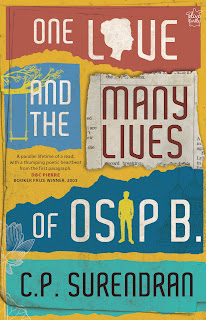
 From  C P Surendran's latest novel, One Love And Many Lives Of Osip B, published by Niyogi Books, we give below excerpts from a chapter titled,  The Mass Destruction of One Man. The excerpts deal with the disintegration of a writer, Arjun Bedi, facing allegations of sexual misconduct , who is the mentor to the teenage protagonist of the novel, Osip B.


When I arrived at Whispering Woods, there were already people in Arjun’s living room. The smell of alcohol and tobacco mixed with perfumes licensed the air. The hall was packed. It was late, though guests still trickled in.

‘But you had a birthday party earlier in the year!’ I said.

‘This is the roaring ’20s. We hurtle from one drunken party to another.’ Arjun put an arm around me. ‘That was for Maina. This one is for me, but it is quite political in its purpose.

I must fight by all means the daily and mass destruction of my one life. With silence, cunning, and parties, pagans and vegans all welcome!’

‘URF?’

‘They want to see blood. The crowd needs to see fresh blood. It has a way of turning everything into a sport.’

It seemed unfair to ask him for help.

‘Everything all right?’ Arjun asked.

‘Well…’

‘What’s it?’

‘The thing is…Can you come to my school?’

‘What for?’

I told him in an urgent whisper, every word I uttered more absurd than the one preceding it.

‘This is serious business, OB. How did you get into this mess? You are worse than me. But I am afraid I can’t get into this, not now.’ 

‘You are a famous man. A great writer.’

‘Fame is what they can use against you. Remember what I told you some time back? You wouldn’t believe it, it is organized frenzy.’ Arjun looked around. ‘These little parties I throw are my way of holding on to what little I have. It’s a dangerous world now, anyone can work out their revenge from rest rooms, you understand? These are toilet revolutionaries,’ Arjun grimaced. ‘But, what the hell are you up to? An affair with your teacher followed by murder?’

‘No, not murder. Exhumation.’

‘It’s as good as murder. Hell, it is worse!’

Three retired men of the military came up to Arjun and wished him happy returns loudly. Their chests were covered in stars and medals. The shorter, thickset one, with a luxuriant, twirled mustache, seemed always one step ahead of the other two.

‘You must formally join our political party, Arjun Saab,’ the short general said, staring hard at Arjun. But his eyes twinkled. ‘You promised.’ They had, it turned out, recently started a political outfit at the behest of Arjun.

‘Ah, my generals,’ Arjun said. ‘India’s best.’

‘We registered the party. You can’t back out now,’ the second man said.

‘The New India Political Party, NIP,’ the third said.

‘RIP?’ Arjun said.

The generals laughed helplessly, holding on to each other's shoulders.

‘Arjun Saab, Arjun Saab,’ the leader shook his head as if Arjun was too much. ‘Really, you are our star. Our torch. Our…’ He looked around at his friends for help, but they only smiled in encouragement.

‘Of course I will join NIP. On one condition, but.’

‘What’s that?’

‘I’ll be the treasurer. For life.’

They all threw their heads back and laughed again. They were an uproarious bunch.

‘Jokes aside, Arjun Saab, the retired soldiers of this country can no longer bear to see the nation going down the drain. It’s as you might say, RIP India or NIP India.’ The short general said. ‘We are looking for a writer with the rank of a general.’

‘All right then, I will be your Maxim Gorky.’

The generals raised their eyebrows.

‘He was the head of Union of Writers under Stalin,’ Arjun said.

‘M. applied to him for two sweaters and a pair of trousers. He didn’t get the trousers, I think,’ I said.

‘This is Osip Bala Krishnan. He is Russian,’ Arjun repeated his old joke.

They ignored me.

‘Let’s talk about NIP.’

‘Aren’t we all a bit too old to start a change-India party? Mind you, I am not talking about me,’ Arjun said.

‘You will bring the average age down, Arjun Saab,’ the second general said. Everybody laughed again. One of the generals shook his head as if to say this is just too much. He had tears in his eyes.

‘Really, we are as good as the young,’ the short general said. ‘I challenge anyone here to hand-wrestle me.’ He looked around the room, but mostly in the direction of a woman in blue jeans and kurta. There was a bespectacled young man with her, holding her wine glass as she was answering a call; her other hand was in a sling. ‘What corruption! Moral, financial, physical. Is this what our founding fathers sacrificed their lives for?’

‘Are you addressing me, or my neighbour, general?’ Arjun said. ‘Careful. That’s Dev and Diya. They represent the rights of the underprivileged and head a social media campaign against me. I have some trouble on the patriarchal front as you might know.’

‘Love thy neighbour as thyself.’ The general with tears of joy in his eyes said.

‘Love thine own neighbour, not mine,’ Arjun said.

This time the three generals nearly doubled up with laughter. The short general put out a hand in the direction of Arjun, pleading with him not to be so funny. ‘I may be gazing elsewhere, but I look up to you,’ the short general said, straightening up. ‘As for the campaign against you, it is chaff in the wind, Arjun Saab. Nothing will shake our faith in you.’

The short general hugged Arjun briefly, and turned their attention to someone seemingly important entering, a politician, from the white khadi he was wearing, and marched toward him.

Arjun swallowed a drink neat and gravitated to Dev and Diya, who had moved out into the balcony. I straggled along by Arjun’s side in grim fascination.

‘I have had to work on through someone to make them come here,’ Arjun whispered. I later learned that the 'someone' was the old man with the German shepherd. He was Diya's uncle—and Arjun's friend—and the couple were living in a flat of his in the building, a rent-free arrangement, Arjun said.

Dev and Diya were stiff, and it was clear they wanted to stay by themselves. They had done Arjun a favour dropping by.

‘Dev and Diya, Thank you for coming.’

‘We will be only a minute here.’ They seemed assured and self-sufficient in the strength of their good intentions.

‘Of course. I know you are fighting a good cause. And this is perhaps not the time to ask…’

‘No,’ they said in unison.

‘I am not a tactful person…’

‘We know that, don’t we, Dev?’

‘I knew this was why he insisted we come. Don’t tell me I did not warn you.’ Dev said to Diya.

‘I can’t help it, and I didn’t think I would say it, but all these daily mass mails to publishers, festivals, editors …,’ Arjun said.

‘Well?’ Diya said.

‘It seems so much work.’

‘Mr Bedi, please don’t worry about our workload. We will stop when you apologize,’ Diya said.

‘Apologize for what?

‘For your nude dancing and provocative comments and sexist columns. There were many good people in that party. They are deeply offended.’

‘It was a rave party…so many years ago.’

‘But only you were nude. And you put your arm around a victim’s waist.’

‘I was wearing something, not much, I admit, but something.’

‘But you were the only one nude,’ Dev said.

‘There were others in other rooms.’

'Mr Bedi, a writer must represent the spirit of his age, and overcome it. You have failed,’ Dev looked away in resignation.

‘At a seminar, you said, “What’s everybody’s problem with the dick!”’ Diya said.

‘It was both a joke and a question,’ Arjun said.

‘Your whole discourse is wrong,’ Diya shook her head.

‘And your columns! We can’t allow that kind of writing. You may think it is daring and intellectually provocative. That is your vanity. It is just bad form and poor taste.’ Dev shook his head of long curls. ‘And one poem that turned up on my computer last night, something about the Dark Spider.’

‘“Dolomedes Tenebrosus: Spontaneous Male Death” was the title. The dark spider eats the male partner after sex.’

‘You called the female spider a “b…h”. Language is a social tool, Mr Bedi,’ Dev said. ‘There are norms to be observed. These are sensitive times. There is a historical correction to be made in favour of the female gender…’

‘In favour of Dalits and children, too.’ Diya’s large, earnest eyes left no room for doubt about her commitment to her cause.

‘In favour of the wronged people. What we stand for is a certain much-needed correction in patriarchal politics,’ Dev said. ‘We are conscientious citizens of this country, Mr Bedi, and we can’t let a few things happen on our watch—even if the government is not of our choice, and we have no executive powers,’ Dev’s eyes bored into Arjun’s. ‘We have an obligation toward civilized society. But this is no place to talk about such matters, is it?’
C P Surendran

‘You are depriving me of my right to earn a living, in effect. That’s not a constitutional or even a liberal thing to do. Any accused has the right to speech and work. In any case, you are not the court,’ Arjun said.

It appeared to me that the intended reconciliatory meeting was not going the right way.

‘If the State is regressive, and the institutions are failing us, the citizen must step forward as the culture dispenser. There’s no space in our world for exploitation of any kind,’ Dev said.

‘You know you are guilty, don’t you, Mr Bedi?’ Diya said.

‘I…’

‘The fact is your kind of voice has had its day,’ Dev said.

Tuesday, December 14, 2021

Self-critical expression, censorship, freedom of speech & hate speech

Self-critical expression lends a moderate hue to any issue under debate. It can and does have a positive impact on artists and journalists. Both artists and journalists have to necessarily walk the tightrope between freedom of expression as enshrined by the law, and hate speech, which is prohibited by the law. And there is a thin line that divides these two concepts. Self-critical expression rather than censorship is the key to a democratic society. Self-critical expression is self regulated; censorship is imposed by an extraneous authority.

Self-critical expression is inherent to any conversation where more than one view is being debated or discussed. An individual develops and comes to hold views and opinions over several years, and through borrowed or lived experiences. These often turn into dogmas and are justified as ideology. 

The easiest way to test them is to put them through the test of a sincere discourse. When one hears another side of a fiercely or a dearly held opinion in a debate, one begins to comprehend another dimension to that opinion. And that, in an individual who is open minded, results in a better understanding of any issue. Significantly, even if the person doesn’t change her views on the subject, this exchange of views is important because it provides her with a wider perspective.

For a journalist, self-criticism is not always necessary. For a reporter, it is easy to overcome an inherent bias by actively seeking a view or views that are diametrically opposed to her views. This is prima facie of paramount importance to ensure balance in reportage.

However, one must draw a line in being fair. Fairness should not automatically mean that two opposite views are considered and included in a news report to make it balanced. On some occasions, it is not at all necessary to appear to be fair, especially when one is reporting about hate crimes, police brutality, sexual abuse of minors, gender-based inequality.

Also, columnists are read, and are popular and controversial mainly because they hold a point of view which is biased and almost never self-critical. The most recent example is of Don Cherry, the sports broadcaster, who was fired in 2019 because he made unguarded comments about immigrants not wearing poppies for Remembrance Day.

Censorship in the media is as old as media itself. There are multiple reasons for censorship in the media, but the main reason is to earn revenue. The other is to adhere to socio-cultural and political moorings of the society within which the media operates.

The media in the West cannot stop finding fault (justifiably) with autocratic societies, where religious or political ideologies, determine societal debate. But the same media doesn’t see anything wrong with the inherent fault lines in Western societies.

For instance, in Canadian media, there isn’t enough exploration and dissection of the continuing absence of adequate reportage of issues pertaining to Canada’s indigenous population, and their right over Canada’s lands and resources.    

I don’t think there is anything wrong in criticizing religion or an ideology objectively. However, almost always such criticism is based on prejudice and is motivated by hate.

The government, the establishment plays an important role in this debate. In his essay The Etymology of Terror, published in New York Review of Books, Matt Seaton says, “We have reached, then, a point in the etymology of terror at which governments have assumed the right to designate any specific person or group, literally anyone they don’t like, as terrorists. By one new standard for terrorism, it can apply to human rights lawyers and researchers who irritate government officials, because to decry state violence has become itself a terrorist crime. By the other new standard, it can apply to anyone who happens to be in the wrong place at the wrong time—the time and place being lethally adjacent to wherever the US is hunting “war on terror” adversaries.”
 

Prejudice can only be combatted through objectivity. Such objectivity must necessarily include self-critical expression. Lee Marcle, the eminent Metis author, who recently passed away, narrated a poignant incident to the CBC when her book I am Woman was published in 1988. She asked to be included in the Vancouver Writers Festival to launch her book of essays, but was denied an invitation. “So I went there and got up on stage and grabbed the mic and I did a reading,” she said. “I said, ‘Right now you are in my village, this is my original village and I am going to read here.’”

The situation has changed today, but not much. I think, it is important for the non-mainstream artist to create a parallel mainstream that promotes their respective culture within the Canadian milieu, and context. We can only fight neglect and hate by creating an alternative space that promotes an alternative interpretation of a Canada that we want to create. This requires proactive intervention, and not blaming.

In his essay Canadian multiculturalism and national identity – a 50-year relationship, Varun Uberoi of Brunel University, London, England, says, “…if people’s conceptions of their political community include cultural minorities as normal and equal members of it, these conceptions help a culturally diverse citizenry to visualize themselves as a group. But those with such inclusive conceptions are also less likely to exclude and discriminate against minorities as minority cultural differences are not seen as something to fear or to avoid.” (Published in Multiculturalism at 50 and the promise of a just society, CITC Canadian Issues).

There isn’t adequate concern over the general ignorance of the Canadian mainstream to the rich diversity that has been (and is being) created in Canada politically. Multiculturalism is 50 years old. And while it has achieved much, it is in essence an empty slogan. 

New Writing


Lease - short story published in the Maple Tree Literary Supplement

https://www.mtls.ca/issue25/mayank-bhatt/

Excerpts

“I hired a private detective to check your past,” Myrna said.

“You did what?” the wine almost sputtered out of my mouth and I quickly gulped it. I gaped at her, as my jaw dropped.

“I was letting you in my home; I had to take precautions. Nathan – the real estate agent – and Deb agreed.”

I had no idea what to say or to do. Finally, after sitting in a daze for a while, I put down the wine glass and got up to leave. She didn’t stop me. On my way down to the basement, I decided it was time for me to move out, to rent a new place.

Myrna knocked on the door the next morning. She walked in, carrying two mugs in one hand and a kettle in the other, the dog rushed inside, and sniffed at my legs.

“Good morning. Let us have tea together. You left abruptly last night.” She handed me the mug and poured hot tea in it. She seemed flustered, she sat on the only chair in the room, as I walked to the bed. I was groggy and feeling heavy in the head.

“Look, I am sorry.”

I looked at her and took a sip of tea. It instantly cleared my head. “I am curious to know, what did the detective find out?”

“Oh, nothing at all of any consequence.”

“You did find something recently because your attitude changed.”

“Yes, thanks to a huge coincidence. Deb met your stepdaughter’s partner Ruth. She gave you a glowing reference; told her something about how years back you saved their relationship by arguing with your ex not to force your stepdaughter to go to Kitchener.”

I was again gaping at her; speechless and clueless. I sipped tea without talking. Then, I told her that I would be moving out.

“I know you are upset, and I said I am sorry, and I mean it. I will make it up for you.”

I kept quiet. I had to move out. I wanted to ask her but didn’t whether she would have gone through such a vigorous process to ascertain the past of a renter, if that person was white.


Interview in the Artisanal Writer

 
To me it posed a challenge of portraying the complexity of being a Muslim in Canada, and I’m not a Muslim. In recent years, there have been intense debates in the literary spheres about ‘cultural appropriation.’ Would I be able to portray with accuracy and empathy the life of a Muslim family, the family dynamics, and the inner turmoil? I was born in a Hindu family, but my dad was a socialist, and I grew up to be an atheist. Also, as a journalist, I covered religious violence that wreaked havoc on Bombay in 1992-93 and recorded the misery Indian Muslims suffered. Pertinently, I’ve been married to a devout Muslim for over 25 years. I believe that a novelist’s primary responsibility is to tell a story competently and responsibly. Innumerable novelists have created a world in their novels that is palpably real without ever being even remotely connected to the world they create. I have done so in Belief, and I’ll leave it to the reader to judge whether the novel succeeds in portraying the complexity of being a Muslim in Canada.

https://artisanalwriter.com/2021/11/01/mayank-bhatt/

Sunday, August 22, 2021

New writing

My First Cancer Birthday: A Diary of Coping

August 20, 2021

https://www.thebeacon.in/2021/08/20/my-first-cancer-birthday-a-diary-of-coping/

A year after he learnt of his fatal illness, its traumatic coping and chemotherapy, Mayank Bhatt dwells further on his struggle to find meaning to life and death, in love and writing.

Sunday, August 01, 2021

One Love and the Many Lives of OSIP B: Cp Surendran

Guest Post: Beena Vijayalakshmy

“If it be true that every novel contains an element of autobiography – and this can hardly be denied, since the creator can only express himself in his creation – then there are some of us to whom an open display of sentiment is repugnant.”

-     Joseph Conrad

These are the words that first came to my mind as I sat entranced after reading One Love and the Many Lives of Osip B. by Cp Surendran. The book was launched recently.  I read it off Kindle.

Cp Surendran has effortlessly juggled the many roles that he has come to don in his eclectic career. While I had been familiar with his brilliant poetry and his many essays, I had not read any of his works of fiction until Osip came along.  And dare I say, he makes for one demanding author who elevates his readers on to the next level and intrigues them with the blood and beat of language.

The story of Osip defies description. And deliberately so. To put it simply, it follows the journey of the protagonist, Osip Balakrishnan, an eighteen-year old who falls irresistibly in love with his British teacher, Elizabeth. When she rejects his love and takes off to England, Osip pulls off a stunt that almost gets him arrested. In a desperate attempt to win back the one love of his life, he follows his destiny to England and in the process, discovers that his future is inextricably linked to his communist past.

The narrative is jammed with several themes, plots and digressions that it is practically impossible to do justice to the book in the space of a short blog. Suffice to say, it is one heady ride that is anti-woke and is bound to raise many eyebrows. The novel touches upon several contemporary themes such as individualism vs groupism, cancel culture, the rise of nationalism and Islamophobia, the fall of pluralism, beef vandalism among others. It is a severe reproach of the authoritarian India that is antagonistic to dissent in any form, the emasculation of the Fourth Estate by the powers that be, the culture brigade that polices practically every sphere of social life in India, and holds to ransom anyone who dares to deviate from their idea of moral rectitude.

However, what intrigued me most were the autobiographical elements of the book. Being familiar with the instrumental change and the drastic administrative reforms brought about by the rise of communism that revolutionized Kerala of the 60s, the allegorical insinuations to the author’s father and his many contributions to the Communist establishment in Kerala were unmistakable. In his heyday, rationalist and literary icon, Pavanan, was a force to reckon with, an undeniable presence within the Communist circles in Kerala. However, in his final years, he led a life of relative obscurity, after being afflicted with Alzheimer’s. As does Narayan, Osip’s grandfather. Incidentally, Pavanan’s given name was also Narayanan Nair. The pain of watching one’s loved one disintegrate right in front of one’s eyes is very poignantly captured in the novel.

The existential despair and the travails of a battered journalist, Arjun Bedi, who is discredited and exiled by woke groups – “toilet revolutionaries”, as he calls them - is reminiscent of the author’s own trials and tribulations in recent times. The book worms its way into one’s subconscious, rendering the surroundings out of focus in stark white. The writing is vigorous, the prose almost poetic to a fault, the plot complex yet structured. There’s a painterly minimalism to the language – every word necessary, every word taut. The poetic depth of the love story leaves one with lingering thoughts of love and loss, while the honest writing forces one to find expression to those parts of our experiences and reject everything superficial.

Every once in a while, there comes along a book that hits some very real moments for a reader. Osip comes in the middle of a pandemic, as a virus ravages the nation. The book was recently launched and is invariably bound to revive debate on several contemporary issues. As it rightly should.

-------

Excerpt from One Love and the Many Lives of Osip B. Cp Surendran Copyright 2021

Love, the Word Known to All

I sat down at Cheers, a cheap coffee place near the Oxford Railway Station, not bigger than a stall, where I had found myself in my aimless walks this mid-morning, and where you could stand around round plastic tables in red and white, and have a coffee and a croissant for one pound. One side of the place was red bricks, and the other a mirror.

The man behind the counter was young and bald, and had a face that invited confidences. I bought the coffee without looking him in the eye, and placed it on a red table. I had a headache coming. Its source was precisely at the centre point behind my eyelids. Soon it would radiate around my head. I checked my phone, read again the message from Arjun. Dev had posted the party scene where Maina was having a meltdown on social media. Diya shared the post with a kind of dissenting note. She said that it was a personal moment at a private party, and, ideally, should not be put out; but Arjun was a public figure, and his wife’s ‘observations’ about him were helpful to understand the domestic abuse of the ‘benevolent patriarch’. She said she would have more to say on the issue in a forthcoming book. Dev had masked Maina’s face in his video.

 ‘The terror comes in waves,’ Arjun said. They had come up with another case where he had asked an artist if she were her own nude model. Arjun said he did ask the artist the question, but it was out of genuine curiosity. ‘Today,’ Arjun said, ‘I awoke to hear someone moaning, like a hurt animal, and found it was issuing from my throat, so I will go and apologize to them and see if this thing can be stopped, but what’s there to stop now? You see, Osip, although one needs forgiveness or appreciation from no one more than one’s detractors, and though their file on me says I am well versed in the English language and the uses of irony, I say it all quite plainly: I am tired, and I must learn to die with this, though Dev and Diya have offered a forum on their online portal for me to apologize. Hmm. This offer Osip, was preceded by an anonymous call on my landline. The caller, a male voice, merely said, “Hello rapist, good morning” and cut the call. And, so, I ebb and eddy toward my exilic status, which I console myself is an essential stage of a writer’s evolution, but equally, I am aware now, that even this thought could be an assuagement of my vanity. In short, I am no longer sure of myself. Stay good, and let me know if you need anything, money, etc.’

I sipped the hot coffee. English coffee always smells better than it tastes. A heavy-set woman in a tall black hat, black leather jacket, and black high boots came in with two black poodles, talked to the man behind the counter in a whisper, laughed, and left, glancing at me. The cold air was heavy with perfume in her wake, and triggered the first stab of my blinding headache. I leaned my head against the mirror. ‘Poor Arjun,’ I thought. I could not think of a repentant, apologetic Arjun. I closed my eyes to contain my headache.

‘Now I present to you my 1935 poem, Ode to Stalin, seeking his forgiveness. “Though I am not yet worthy of having friends,/Though I am not sated with bile and tears, / I still seem to be seeing him in his greatcoat, in his cap, / On the wonderful square, with his happy eyes…// ).’” ‘Gladen’kii stishok. Facile doggerel.’ ‘Yes, nothing in the great Russian language, with all its wide vowels and gushing sibilants, justifies or accommodates it. The language fails when the poet is false to his situation. And the situation here is stark, simple: there would be no reprieve. Only more Siberia from the big man, and there is enough Siberia for all to go around with, and mocking laughter of other doggerel writers.’

 ‘Are you talking to yourself in a foreign language?’ the man behind the counter had come around, and was now considering me with his kind, bulbous eyes. ‘No. I was thinking of something.’ ‘I thought I could hear your thoughts, mate. I don’t mind, except the customers might take fright.’ I picked up the coffee and left, my head on fire, carefully stepping over the little puddle of poodle piss on the floor, mystified which one of them did it and exactly when. It seemed the woman in black had come a long time ago.

Buy the book: One Love and Many Lives of OSIP B

Watch Vani Tripathi's interview Cp Surendran: Kalinga Festival 

Monday, October 12, 2020

Wednesday, June 17, 2020

Thank you!

I have reached a stage in my life where I don't need to say anything more.

It is time for introspection.

It is time to be with Mahrukh and Che, and plan for a secure future for them.

And to be with Durga and Sonal, and Shakera and Farrukh.

So, after a dozen years of active blogging, I'm going to stop now. 

There's enough here in this space to keep you occupied for a long time if you chose to browse through the past posts. And some of it may actually be interesting.

Thank you for stopping by.

Thank you for being a part of my journey.

Remember me as that awkward friend who always cared, and who didn't know how to show that he did. 

Thursday, April 30, 2020

Remembering Rishi Kapoor


To write about Rishi Kapoor in the past tense is incredibly sad.

As an actor, Rishi Kapoor was an institution. His legacy will last as long as there is cinema. 

But he was more than just an actor. In the last decade or so he had become a social media influencer, a twitter aficionado.

This blog post, however, is only about Rishi Kapoor the film star who although he came from a privileged background, thrived in a highly competitive environment for four decades because of his immense talent.


There are already a number of excellent obituaries about Rishi Kapoor; many written by people who knew him personally and met him frequently; mine is probably not going to match those either in erudition or depth. 

This blog post is just my tribute to an actor who will always remain an integral part of my adolescence and youth. I didn't know him personally. I didn't meet him, ever. 

To the generation that became interested and aware of the tremendous appeal of popular Hindi cinema in the 1970s – he was and will always remain a lodestar. Rishi Kapoor was that young, reckless romantic, willing to risk everything for love, and who almost always nearly lost everything but got the girl.


By the 1970s, the dreams of a post-independence India were in tatters. There was a rising anger at the system, captured brilliantly by Amitabh Bachchan’s smouldering rage. Rishi Kapoor gave the audience welcome relief from that overwrought and essentially futile fury.

Right from his debut as a lead actor in Bobby (1973), where he was the personification of young love with its all its doe eyed innocence, Rishi Kapoor captured our hearts by his competent skills as an actor. 

He was a despondent, hopeless lover in Laila Majnu (1976), as a crossdresser in Rafoo Chakkar (1975), as a carefree quawaal in Amar Akbar Anthony (1977), and a dafli-player in love with a mute dancer in Sargam (1979) – my favourite Rishi Kapoor film.


All his films from that era are equally well-remembered for their songs.

Rishi Kapoor redefined the song and dance routine that is a staple of Hindi cinema, and although never acknowledged as a great dancer, he knew how to set fire to the dancefloor with his moves.

Although he showed his versatility in every role he played, he was not offered challenging roles, till rather late in his career. The one notable exception was Doosra Admi (1977), where Rishi Kapoor played a young, ambitious man focused on his career and falling in love with an older colleague. His portrayal was bold, mature, but deliberately underplayed. He didn’t let Rakhee, a consummate, top-of-the-line actor of that era, overshadow him.  

In the 1980s, Rishi Kapoor signed up for a whole bunch of utterly unforgettable films. But he did give his fans Karz (1980), a reincarnated revenge saga based on the Reincarnation of Peter Proud; remembered today for its unmatched energy.

Prem Rog (1982), his second film as the male lead after Bobby that his father directed, saw Rishi Kapoor again give a subdued performance. Just as Bobby was centered around Dimple Kapadia, Prem Rog was focused on Padmini Kolhapure. 

Then, came Sagar (1985), the film that relaunched Dimple Kapadia. Rishi Kapoor could have easily been eclipsed by the much-acclaimed Kamal Hasan, but he held his own effortlessly.

I'm sure, he knew his worth as an actor, and would have been full of remorse that he didn't get good roles in his prime. But he didn’t believe in wasting his time waiting for good roles. He made good with whatever came his way, and never flinched from accepting roles that would probably have been rejected by other actors. 

He eagerly accepted roles that played second fiddle to the woman lead in films. Nagin (1986) with Sridevi was a monstrously bad film but was undeniably a monstrous hit. He was equally at ease being the second male lead. All his films with Amitabh Bachchan – Kabhie Kabhie (1976), Amar Akbar Anthony (1977), Naseeb (1981), Coolie (1983), were hugely successful and remain endearing even today. Some, such as Ajooba (1991), were colossal flops, but that had little to do with Rishi Kapoor.

Another trend that marks his career is that despite a string of flops (inevitable, considering he did on an average three to four films a year) every few years, he would turn in a mega success. So, after a protracted lean phase in the late 1980s, he delivered a huge hit in Chandni (1989). 

He will forever hold the record of having launched the careers of pretty young things into movies, and he did that with aplomb, wearing multicoloured cardigans.

The 1990s were not too different from the previous decade. He continued to work in utterly forgettable films but also gave us Bol Radha Bol (1992), which succeeded as much because of him as for Juhi Chawla; Deewana (1992) which succeeded because of Shah Rukh Khan; and Damini (1993), which Sunny Deol’s biceps propelled to eternal fame.

Then, after a lean phase, he turned to character roles, and entered what was perhaps the most interesting phase of his career. He was liberated from ensuring a film's success. He could now focus on his performance.

He brought an indescribable insouciance to his role as a father who preferred to pursue his dreams as a photographer rather than be a responsible dad in Hum Tum (2004), you couldn't obviously like him for the way he treated his wife, but you still weren't willing to dislike him. 

He was wasted as Kajol's dad in Fanaa (2006).

He was nominated for the best supporting actor award for his portrayal of a film producer in Luck by Chance (2009). Delhi 6 (2009) and Love Aaj Kal (2009) again saw him at his subdued best; in both the films he played an aging lover, who having lived it up in his younger days, is unable to comprehend the restrained ardour of the younger generation.

And then, came Do Dooni Char (2010), a story set in lower middle-class Delhi, for which he won the Filmfare best actor; his second after Bobby. He took everyone by surprise with his portrayal of an amiable and yet vicious Bombay bhai in the remake of Agneepath (2012). It was a performance that got under the skin of the audience – it was hair raising, and riveting. 

He followed it up with another incredible performance in D-Day (2013), portraying a character that was based on Dawood Ibrahim. As the lubricious granddad in Kapoor & Sons (2016), he was unrecognizable with layers of makeup, but again won the Filmfare best supporting award. His role in Mulk (2018) won wide acclaim because he brought to life the uneasiness of India’s Muslims in a country that rapidly transformed into a Hindutva citadel.

Rishi Kapoor's passing away is a national loss. There won't be anyone like him. There can't be. 

Wednesday, April 22, 2020

He was my father

Meghnadurga (circa mid-1980s)

A few days back, Rajesh Macwan, a friend, sent me a few lines of my father Meghnad Bhatt’s poem about the advice that a father, who is entering the fifth decade of his life, is giving to his son, who is about to turn 25. 

But before I get into the poem, let me give a brief background. 

According to the Hindu Vedas, the four ashramas (stages) of a human being’s life are 

  • Brahmacharya (bachelorhood, student), 
  • Grihastha (householder), 
  • Vanaprashta (to give up on worldly life), 
  • and the final stage of Sannyasa (life of a mendicant, a life of renunciation). 
Vanaprashta means to enter the forest. When one enters the forest, one begins to relinquish one’s love for material possessions. Typically, that phase commences when a person enters the fifth decade. In most Indian languages, the fifties end in "Van" (51 = ekyavan, 52 = bavan, 53 = trepan, and so on). "Van" is forest. 

In Gujarati, Vanaprastha is called Vanapravesh. Also, in Gujarati, as in other Indian cultures, the advent of youth is a considered period of foolishness and clueless rebellion; it’s when a person, and especially a man, is no better than a jackass. 

The exact age when this transformation from a human to a jackass occurs is when a man turns 25-year-old.

Gujarati language has a term for it: Gaddha-pachisi. An approximate translation would be jackass 25, an age when young men are no better or worse than jackasses. A relatable reference is the contemporary popular psychological term ‘quarter life crisis’.

Now, let's get back to the couplet that Rajesh Macwan sent me. 


I have attempted to translate the poem into English. I'm not particularly good at translations, but I wanted to include the poem in this blog post which I'm posting on the 23rd death anniversary of my dad, so, please indulge me.

A simpler translation of the title of the poem that Rajesh sent me would be: 

Advice of an aging father to a young son 

But it wouldn’t capture the essence of the angst that the original title and the poem possess.

So, let’s go with the bells and whistle title: 

Advice of a Vanapravesh-aged father to a son who’s on the anvil of Gaddha-pachisi. 

I'm not sure if the improvised, hybridized (English-Gujarati) title works, and if it doesn't go back to the simpler version above. 

And now the poem’s translation

Till yesterday

The one who wore his father’s spectacles and romped around pretending to be “Pappa”

Has suddenly turned critical of bapu-cracy (gerontocracy), Mayank?

There never really was a gap between us, ever

The unasked, unanswered question that ends the poem is: "Or was there? (a generation gap).

Meghnad wrote this in 1985. He turned 50 that year and I was 23. He was at the height of his creativity. He was a successful union leader, having unionized the clerical staff of Mafatlal Group, in the heart of Bombay's corporate world - Nariman Point. 

His journalism was flourishing. He was writing for Janmabhoomi and Pravasi (edited by the redoubtable Harinder Dave). Although rather late, his first collection of poems Chhiplan was published in 1980 to good reviews, and his second collection Malajo would be published in a couple of years. During the decade, he won recognition as a poet from the Gujarati literary establishment. 

On the other hand, I was at a crossroads of my life. I didn’t want to do what I was doing – chartered accountancy, and wasn’t sure I could turn journalism (at that time my steadfast interest) into a vocation. 

He didn’t lose patience at my indecisiveness, and what in retrospect was clearly a sheer lack of purpose. 

I’ve often blogged about Meghnad here, but it has mostly been of how deeply he has influenced my thinking. I haven’t written much about him as a father. And more than a poet, a union leader, a committed leftist ideologue, he was a father.

I could fit a book of the many instances that I remember of him being a father. Today, I’ll narrate just a couple. 

On the evening of my sister’s wedding, after she had left with her husband’s family, Meghnad broke down and wept inconsolably. Nothing would make him stop. He didn’t want to stop. He cried for a long time, lying on the bed. 

My grandmother, my mother and I stood near him, gaping at each other, not knowing what to say or what to do. Later, I asked him the cause of his utter desolation, but he didn’t answer. He never talked about it ever. 

I saw my father cry only twice. The second time was when he reached Bombay from his maiden trip to the United States, a couple of years before he passed away. 

And, here's another instance of him being a dad.

I think the males in the Bhatt family have a genetic defect in the eyes. They all have to wear glasses at a young age. My father, my son and I have had to wear prescription glasses at about the same age. In my case it was in 1974, when I was 12 years old. 

We had moved to Teli Gali in Andheri a couple of years back, but my parents were still unfamiliar with the place, and they had excellent, long-nurtured relations in Kalbadevi-Princess Street area.   

So, I had my eyes tested at the Round Building (at the intersection of Kalbadevi Road and Princess Street) and my glasses made at Ganko opticians (at the intersection of Old Hanuman Lane and Kalbadevi Road). 

That late afternoon, we were returning home from Ganko. I was wearing prescription glasses for the first time in my life.

It was raining and I was unaccustomed to seeing through the glasses. While descending the stairs at the Marine Lines station, I nearly slipped and would have tumbled all the way down to the platform, had Meghnad not grabbed my hand and pulled me up. 

He was angry. That was rare because he was seldom angry. But it was momentary. He pulled me to him and said in a calm tone. “We must be very careful.” A little later, when we were inside the local suburban train, he said, "We must start living in Andheri."